What is the difference between the two routes?
The Digital Nomad Visa is for money you earn by working remotely for foreign clients or an employer. Residenza Elettiva is for money that arrives without you working, and it does not permit work of any kind. Different income proofs, different tax treatment.
How much do I need to earn for the Digital Nomad Visa?
From €24,789.93 a year, earned from clients or an employer outside Italy. Some consulates quote €24,789. You also show a qualification and at least six months of documented remote work.
What is the permesso di soggiorno?
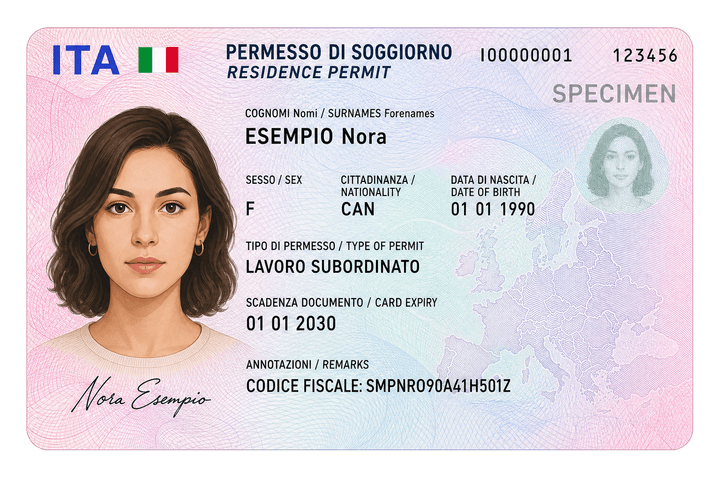
It is the Italian residence permit. You request it within eight days of arriving through the post-office kit, then give biometrics at the local police headquarters, the Questura. The first permit usually covers one year; the Digital Nomad permit is renewed every year, and on elective residence the authority sets the renewal length.
Can I use the €300,000 neo-residenti flat-tax regime?
You can apply if you are becoming an Italian tax resident and have not been one in nine of the last ten years. It replaces Italian tax on all foreign income with a fixed €300,000 a year for fifteen years, plus €50,000 for each family member. The option is exercised in your first tax year, only after a favourable ruling from the Agenzia delle Entrate, and we coordinate it with an Italian tax advisor as part of setup. From 1 January 2027 the regime moves into Italy's new income tax code, which keeps it.
Do I need to buy property in Italy?
No. A registered lease of twelve months or longer satisfies the housing requirement on both routes. Many people buy after the first year, but it is not a condition.
Can my family come with me?
Yes. Your spouse and children under 18 can come on both routes, and Residenza Elettiva also covers dependent adult children who live with you. The income you show rises with family size: Residenza Elettiva has no official formula, and several consulates ask about €31,000 a year per applicant.
How long until Italian citizenship?
Ten years of continuous legal residence, with no long absences. Italian citizenship is EU citizenship. Citizenship by descent (jure sanguinis) is a separate route: since the 2025 reform, new descent claims are limited to applicants whose parent or grandparent holds, or held at death, only Italian citizenship, or whose parent lived in Italy for two consecutive years as an Italian citizen before their birth.
What if I have Italian ancestry?
Citizenship by descent (jure sanguinis) is a separate route. Since the 2025 reform (Decree-Law 36/2025, converted by Law 74/2025 and upheld by the Constitutional Court in judgment 63/2026), someone born abroad who holds another citizenship qualifies only if the claim was filed by 27 March 2025, a parent or grandparent holds or held at death only Italian citizenship, or a parent lived in Italy for two consecutive years as an Italian citizen before the applicant's birth. Many descendants in the US, Argentina and Brazil no longer qualify. We check the line and the documents on the first call.

 Portugal
 Spain
 France
 United Kingdom
 Germany
 Italy
 United States
 Hungary