Portugal
 Spain
 France
 United Kingdom
 Germany
 Italy
 United States
 Hungary


The lowest income bar in Portugal.
€920 a month for a single applicant, against €3,680 for D8 and about €2,300 for D3. Add 50% for a spouse and 30% for each child, and we calculate the household figure before any document is ordered.


Countries
Portugal · passive income
Live in Portugal on pensions, dividends, rent or royalties, from €920/month. It is the lowest income bar among the Portuguese routes in this set.

What D7 gives you
Income you already receive, without working for it, is enough to move a whole household to Portugal.
€920 a month for a single applicant, against €3,680 for D8 and about €2,300 for D3. Add 50% for a spouse and 30% for each child, and we calculate the household figure before any document is ordered.
Pensions, dividends from a company you do not actively manage, rent from property abroad and IP royalties.
Spouse, dependent children and dependent parents apply alongside you. Portugal accepts parents as dependants more readily than most EU routes.
Either the money is there and documented, or it is not. That makes D7 the most predictable of the D-class routes to evidence.
A 4-month entry visa, a 2-year permit, then a 3-year renewal. Permanent residence at 5 years, citizenship at 10 (7 for EU citizens and nationals of countries where Portuguese is an official language) under the rules in force from 19 May 2026.
D7, D8 or Spain
Most people weighing the D7 are choosing between three things: staying passive in Portugal, switching to remote work on the D8, or taking the Spanish Non-Lucrative Visa instead. This is how they differ on the points that decide the case.
If your money does not come from work, D7 has the lowest income bar of any Portuguese route, and the proof is close to binary: either the money is documented or it is not.
What counts as passive income
The consulate looks at the source, at who controls it and at whether it keeps arriving. We classify every stream before the evidence is built.
Public and private pensions need current entitlement evidence and matching bank receipts.
A clear case joins the lease, the deposits and the relevant tax records. We prefer about twelve months of deposits; posts such as London ask for at least three months. We structure the proof the way AIMA expects to see it.
Dividends from a company you do not actively run, royalties, deposit interest and annuities count when the source and the recurring payments are documented.
Freelance and self-employment income point to D8. A company you actively operate points to D2.
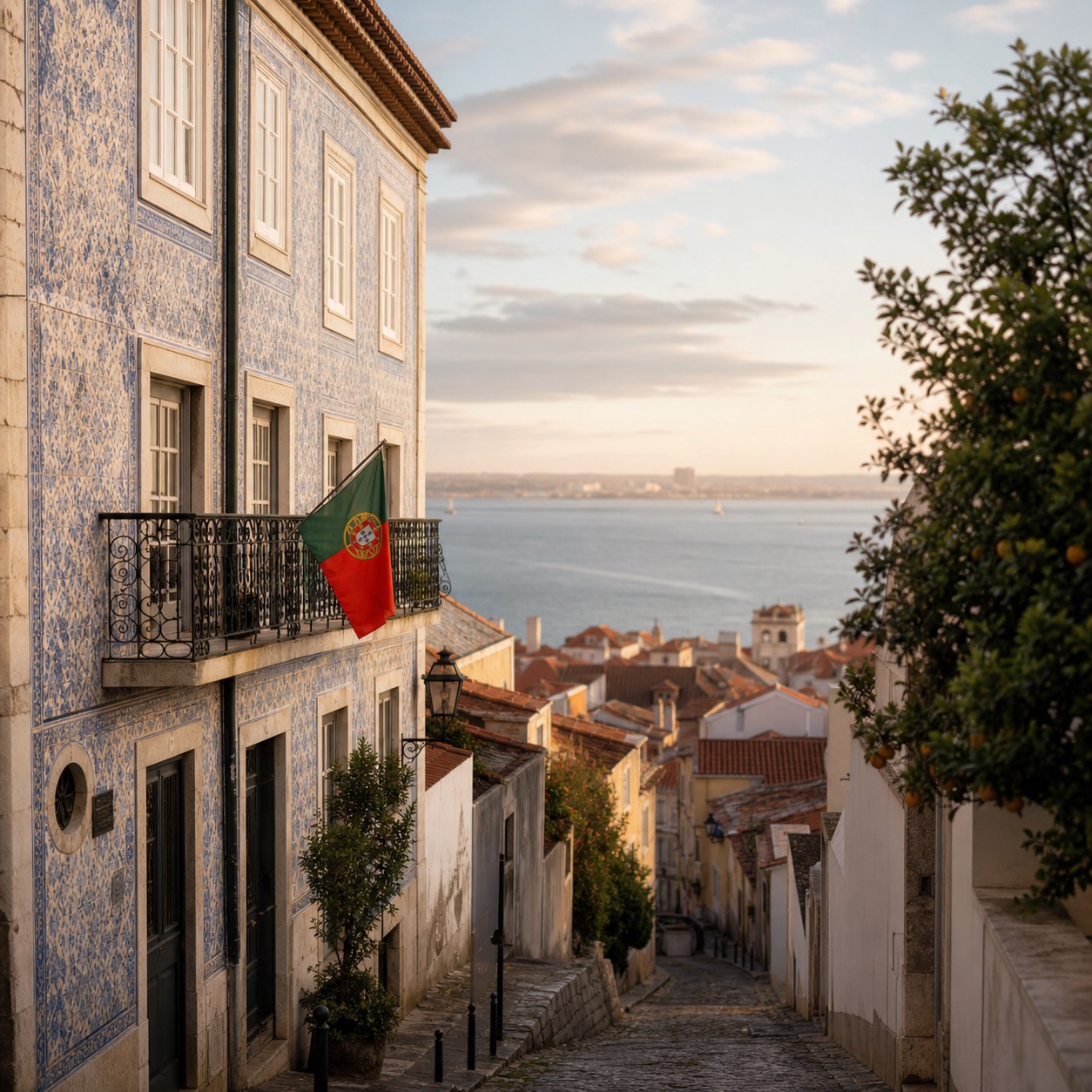
Portugal without a job
The D7 is the paperwork. This is the life it buys, and the one tax fact retirees need before they set a filing date.
Cost of living, healthcare quality and EU mobility make Portugal the default choice for residents who do not work.
AIMA does not publish a D7-only count, but it issued 337,880 new residence permits of all types in 2025; the D7 remains the standard route for retirees and people living on passive income.
Residents use the public SNS, usually topped up with private insurance from around €40 a month.
NHR closed to new entrants on 1 January 2024; the transitional window's normal registration deadline was 31 March 2025, and a late registration covers only the remaining years. IFICI does not cover pensions, so a foreign pension is taxed at standard progressive IRS rates.
Plan the tax before you plan the move.After 183 days a year in Portugal you are a Portuguese tax resident. We time that trigger with your tax adviser rather than discovering it after the permit arrives.
Fit check
Use this as a first filter. We confirm the route against every income source and the full household calculation.
D7 is likely worth checking if
Check another route if

Evidence file
The source documents and the actual deposits have to tell the same passive-income story.
Pension award, dividend statement, rental lease, royalty agreement or equivalent source proof
Bank statements showing that the declared income is received regularly
€920 for the main applicant, plus 50% for a spouse and 30% for each child
Lease, deposits and relevant tax records; we prefer about twelve months, and posts such as London ask for at least three
Accommodation, health insurance, savings, NIF and the required forms
Passport, criminal record and civil-status or dependency evidence for every applicant
From income check to permit
From the first income review to the residence permit, one dedicated case manager handles every step, with a lawyer brought in where the case needs one. The two authority timings below are ranges we have observed in 2026.
We classify each income stream and confirm the main applicant clears €920 a month, add 50% for a spouse and 30% for each child, then structure the proof: pension certifications, dividend statements, rental contracts and bank statements.
We prepare the NIF, the forms and the complete income, bank, accommodation and family evidence set. Many posts, London included, ask for a Portuguese bank account and NIF before you file, and we send a step-by-step guide.
We book the slot where the consulate allows it and prepare you for the appointment. You file at the Portuguese consulate covering your nationality or your country of legal residence, and the consulate issues a 4-month entry visa, typically in 30 to 60 days.
You enter Portugal and prepare the originals for the residence appointment.
Biometrics and the residence permit follow after arrival. In 2026 this runs 9 to 18 months end to end in Lisbon and Porto and roughly 5 to 9 months through regional offices. The legal target is 90 days.
We line up your tax-residency trigger with your tax adviser. A foreign pension is taxed at progressive IRS rates, and IFICI does not cover pensions.
Your case manager, with a lawyer where the case needs one, handles the paperwork. With minimal input from you we prepare certificates, translations and applications, book the appointments, deal with the authorities and track the case.
Service scope
The package covers your case through visa issuance. Any post-arrival work is agreed before you sign.
€2,490 + €990 per family member
For retirees, investors and anyone living on documented passive income.
Check my case for freeGovernment fees are separate: consulate visa €110. AIMA fees for a temporary residence permit (table in force since 1 March 2026): €133.00 application fee plus €114.30 card issuance, €247.30 in total, or €185.60 if filed online. Renewal costs the same. The signed engagement confirms scope and payment schedule.
Compare across countries: Government feesIncome requirementsProcessing times
Other Portuguese routes
Same country, same five-year path to permanent residence. What changes is the proof you have to bring.
Active remote income from outside Portugal, proven over recent months. No employer in Portugal and no company setup needed.

A qualifying role plus a degree or senior experience, and a Portuguese employer. If you do not have one, your foreign company can order the hire and a payroll company employs you for payroll purposes.

No investment minimum, savings of €11,040 and a business plan AIMA will accept. We register the Portuguese company and build the case around the venture.

Embassy; consulates in Boston, Newark, New York, San Francisco, New Bedford
Consulates General, through VFS Global
Embassy; consulates in Montreal, Toronto, Vancouver
Consulate General or Embassy
Embassy; no post in Dubai
Embassy
Family members who file later rather than with you generally wait until you have 2 years of valid residence (Lei 61/2025), or 15 months for a spouse who lived with you for at least 18 months before your arrival; minor or dependent children and the spouse who is their parent do not wait. AIMA must decide within 9 months.
Relovisa in numbers
Residence, work, founder and family cases, filed end to end rather than reviewed.
Historical share of completed cases approved. Open, withdrawn and incomplete cases are not counted.
Clients of more than 30 nationalities, handled from our Portuguese headquarters.
The immigration lawyers and consultants on our case teams bring 10+ years each.
On Portuguese cases we file directly, if a refusal follows a complete document set you provided we re-file once at no additional service fee. Approval is always the authority's decision.
People behind your case
Every case is led and coordinated by Relovisa. We bring in the immigration consultants, lawyers, payroll and tax specialists the route needs, while Relovisa remains your single point of contact.
One coordinated case team, built around the route you actually need.

Leads strategy for founder, business and non-standard cases, connecting the route with the client's business, family and long-term plan.

Leads client and partner operations so case teams, local specialists and next steps stay coordinated from assessment to completion.

Supports UK immigration and Talent Visa case management where licensed legal input is required.

Supports German work immigration cases across process planning, local requirements and case coordination.

Supports Portuguese residence matters that require legal review, representation or procedural escalation.

Supports Portugal D2, D3, D7 and D8 cases, including clients with different income structures.

Supports global mobility for self-employed, founder and highly skilled cases through Portugal D8, D2 and D3 routes.

Supports highly qualified professionals and procedural cases involving residence delays and AIMA proceedings.

Advises on international tax structures and non-standard cross-border situations across Europe, Asia and the United States.

Supports clients whose move intersects with crypto assets, international business and tax planning.
Local coverage for routes and services that require authorised in-country specialists.
D7 questions
The questions that decide whether your income carries the case.
Pensions, rent, dividends from a company you do not actively run, royalties, deposit interest and annuities count. Freelance or self-employment income points to D8 instead.
It is the amount for the main applicant. Add 50%, currently €460 a month, for another adult and 30%, currently €276 a month, for each child. A couple with one child needs about €1,656 a month of passive income.
It can, when the ownership and the income trail are clear. We ask for the lease, consistent deposits and relevant tax records. We prefer about twelve months of deposits; posts such as London ask for at least three months. We structure the proof the way AIMA expects to see it.
After 183 days a year in Portugal, yes. NHR closed to new entrants on 1 January 2024; the transitional window's normal registration deadline was 31 March 2025, and a late registration covers only the remaining years. IFICI does not cover pensions, so a foreign pension is taxed at standard progressive IRS rates. We time this with your tax adviser before you set a filing date.
A special tax rate, a fast passport or a residence you can keep from abroad. NHR is closed to new entrants and IFICI does not cover pensions or passive income, so a foreign pension is taxed at progressive IRS rates. Citizenship takes 10 years of legal residence, 7 for EU and CPLP nationals. The permit assumes you actually live in Portugal.
No. The initial D7 filing is made before you move, at the Portuguese consulate covering your nationality or your country of legal residence.
The Portuguese post covering your nationality or legal residence, before you move: in the US, Washington or one of five consulates; in the UK, London or Manchester through VFS Global; in Canada, Ottawa, Montreal, Toronto or Vancouver; in Australia, Sydney or Canberra. Where there are several posts, your address decides.
The consulate visa takes 30 to 60 days. The residence permit takes 9 to 18 months in Lisbon and Porto, roughly 5 to 9 months through regional offices, against a 90-day legal target. The visa lets you enter; the permit confirms residency.
Yes. Dependent parents who can show financial dependence qualify, and Portugal accepts this more readily than most EU routes. We document the dependence properly.
At the two-year renewal AIMA checks that you still qualify. We prepare the renewal dossier, and if remote work has replaced the passive income we look at moving you to D8.
There is no minimum stay, but a temporary permit may be cancelled if you are absent, without valid reason, for more than 6 consecutive months or 8 non-consecutive months within its validity. Cancellation is not automatic: justify a long absence in advance; professional, business, cultural or social activity abroad is exempt. After five years you can apply for permanent residence with means of subsistence, housing, A2 Portuguese and no prison sentence over one year.
For a Portuguese case we file directly, if a refusal follows a complete document set you provided, we re-file once at no additional service fee, subject to your engagement terms. We do not guarantee approval; the authority decides.
Reviewed by the Relovisa immigration teamPublished July 2026
Start with the income source
Pensions, dividends, rent, royalties: send us the sources, the amounts and who is moving. We confirm whether they clear the D7 threshold, how to document them and what your tax picture looks like.
Check my case for freeFree written check first · €40 live session, credited to your package