Portugal
  Spain
Spain  France
  United Kingdom
  Germany
  Italy
Italy  United States
  Hungary

A step, not the finish line.
The card gives you time to live in Hungary, test the country and prepare your next status. This category does not lead to permanent residence, so we plan the next step from day one.


Countries
Hungary · Self-employment permit
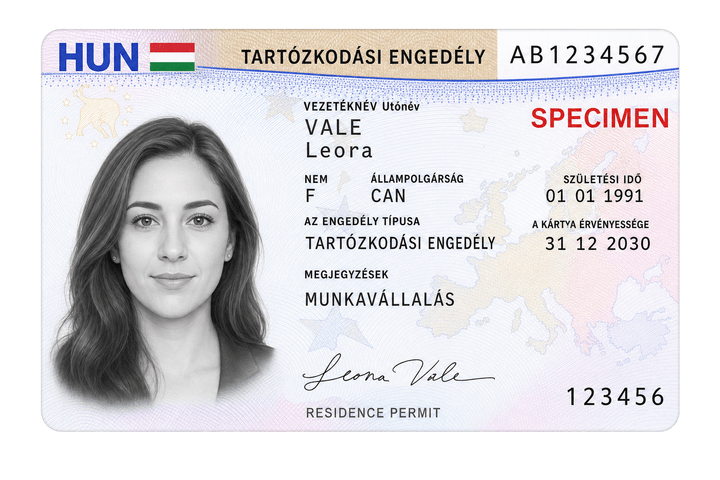
Register in Hungary as self-employed (egyéni vállalkozó) and apply for a residence permit for self-employment. The first card runs for 1 year and can be renewed up to 3 years in total. It is a fast, low-cost way into the EU with no share capital, but it is not a path to permanent residence. We show every limit up front, before any payment.


A fast, low-cost entry
The self-employment permit is built for people who provide services themselves as a Hungarian sole trader. It is not a route for the long term. It is a clear intermediate step: 1 to 3 years of lawful life in Hungary.
The card gives you time to live in Hungary, test the country and prepare your next status. This category does not lead to permanent residence, so we plan the next step from day one.
You do not open a company or put in HUF 3,000,000 of capital. You register as self-employed and provide the services yourself.
The category is not tied to a list of countries the way the National Card is. Russian citizens can file through the consulate in Moscow or St Petersburg.
The service starts from EUR 2,490, against from EUR 6,900 plus capital on the company route. With the card you can travel in Schengen under the 90-in-180 rule.
1 to 3 years legally in the EU: get to know Hungary before opening a company, or prepare your next residence, for example in Portugal or Spain, from Budapest.
An intermediate step or a company straight away
Self-employment and the National Card through your own company solve different problems. Here they are side by side.
If permanent residence is on your horizon, start with the company: you cannot move from self-employment to the National Card from inside Hungary, only by leaving and filing again.
How the procedure works
The card is issued for a year and renewed for the same purpose, but the whole route has a hard cap of 3 years.

You file for a type D visa at the consulate and receive the card after you arrive. The basis is your activity as self-employed and income above the threshold of 24 minimum wages a year.
Filed 90 to 30 days before the card expires. It needs a tax-authority certificate of actual income, reporting that has been met and at least 90 of 180 days in Hungary.
After three years there is nothing left to renew. This category does not give permanent residence, so time spent on self-employment does not count toward a permanent card.
You cannot move to another category from inside Hungary, for example to the National Card through your own company. It takes an exit and a new consular filing, so we plan the next step in advance.

Why Hungary
The route works best when Hungary is a real base for the next few years, not only the country that issued the card.
With a resident card you can travel in Schengen under the standard 90-in-180 rule, as long as Hungary remains the country of your residence permit.
Budapest usually costs less than the large capitals of Western Europe. We work out the rent and living budget for your case before you start.
With lawful residence in Hungary you can apply for a next residence, for example in Portugal or Spain, from Budapest. We check the consulate's conditions for the specific programme.
Address, tax number, health insurance and a Hungarian bank account. All of it is arranged in person after you arrive and gives you a full everyday base in the EU.
The card is not the finish line.Self-employed status needs an accountant, reporting and real income for the whole life of the card, especially by the time of renewal.
Who it suits
This is a first read. Before any payment we check your income, clients, family and how much time you are ready to spend in Hungary.
Worth checking if
Downsides you should know about

Documents
Income, activity and everyday life in Hungary should add up to one clear picture.
Above 24 minimum wages a year: HUF 7,747,200 in 2026. A statement or income certificate at first filing, a Hungarian tax-authority certificate at renewal
Registration as self-employed in Hungary, or a detailed declaration of planned activity if you are not yet registered
A rental contract, ownership, free-of-charge accommodation or a booking
Health insurance for the whole term, or proof that you cover costs yourself
A certificate from every country where you lived for 6+ months in the last 5 years, apostilled and with a certified translation
A return ticket or funds for one, plus an undertaking to leave when the status ends
What it looks like for you
From start to card usually takes 2 to 4 months, a planning range and not a promise. You attend the consulate in person for filing and biometrics, and you have to be in Hungary for the registrations and the bank.
We look at income, clients, family and any plans for permanent residence. If the route does not suit you, we say so before any payment.
We register self-employed status before filing or prepare a declaration of planned activity. With a Hungarian accountant we compare KATA, átalányadó (the flat-rate regime) and the general rules, so you see the real monthly amount.
An activity plan, proof of income, certified translations, insurance and proof of housing. We check the complete set twice.
You file in person at the Hungarian consulate in Moscow or St Petersburg and give biometrics there. The result is a type D visa.
Address, tax number, self-employed registration, chamber of commerce fee and bank account. We walk you through a checklist so nothing is missed.
Regular reporting, income above the threshold, a renewal calendar and a decision on the next step: the National Card through a company, or another country.
Self-employed status, the residence permit and the reporting that follows are one sequence, not three separate purchases.
What the work includes
The main-applicant service starts from EUR 2,490, paid in stages 50/50: half at the start, half at the consular filing stage.
From EUR 2,490 paid in stages 50/50, government fees separate
For people who register in Hungary as self-employed and apply for the self-employment permit.
Check my case for free HungarySelf-employed On top of the government fees, budget for OFFI translations, apostilles, health insurance, rent and a Hungarian accountant. Family members cannot be added to an application in this category; the route is for the applicant alone.
The real budget and a comparison
Government fees, translations, insurance and rent are separate costs you pay directly. Next to them, an honest comparison of self-employment with the route through your own company.
The total depends on the filing method, housing and tax regime. Budget for an accountant from the first month, not from the first check.
01 HU · SELF-EMPLOYED Self-employment is cheaper and faster to enter but runs into the 3-year cap. A company costs more and is heavier to run, but it leads further, to eligibility for permanent residence.
 02 HU · SELF-EMPLOYED OR COMPANY
 Relovisa in numbers
Residence, work, business, family and private-client cases, with clients of 30+ nationalities.
Completed cases only. Open, withdrawn and incomplete files are excluded.
An extended network of immigration, tax and local specialists.
The immigration lawyers and consultants on our case teams bring 10+ years each.
Global Relovisa results. The Hungarian immigration authority decides every application.
People behind your case
Every case is led and coordinated by Relovisa. We bring in the immigration consultants, lawyers, payroll and tax specialists the route needs, while Relovisa remains your single point of contact.
One coordinated case team, built around the route you actually need.

Leads strategy for founder, business and non-standard cases, connecting the route with the client's business, family and long-term plan.

Leads client and partner operations so case teams, local specialists and next steps stay coordinated from assessment to completion.

Supports UK immigration and Talent Visa case management where licensed legal input is required.

Supports German work immigration cases across process planning, local requirements and case coordination.

Supports Portuguese residence matters that require legal review, representation or procedural escalation.

Supports Portugal D2, D3, D7 and D8 cases, including clients with different income structures.

Supports global mobility for self-employed, founder and highly skilled cases through Portugal D8, D2 and D3 routes.

Supports highly qualified professionals and procedural cases involving residence delays and AIMA proceedings.

Advises on international tax structures and non-standard cross-border situations across Europe, Asia and the United States.

Supports clients whose move intersects with crypto assets, international business and tax planning.
Local coverage for routes and services that require authorised in-country specialists.
Hungary self-employment permit questions
Income, clients, family and any plans for permanent residence should be clear before filing, not after.
Only up to the visa. You hand in the documents and biometrics in person at the Hungarian consulate in Moscow or St Petersburg. After approval you have to enter the country: the address, tax number, self-employed registration and bank account are arranged in person in Hungary. Renewal needs at least 90 of 180 days in the country, so living elsewhere and keeping Hungary "on paper" does not work.
No. The law expressly does not issue the permanent residence card to holders of this category. EU long-term residence needs 5 years and the category is capped at 3. So self-employment is a temporary status for 1 to 3 years, not a first step toward permanent residence. If permanent residence is in your plans, look at the National Card through your own company.
Yes. Unlike the National Card, this category has no list of eligible nationalities, and there is no official bar on Russian citizens. Russian citizens file at the Hungarian consulate in Moscow or St Petersburg, directly with the consular section and not through a visa centre. If you live lawfully in another country, you can file there. We recheck the rules before each case.
Income from your activity has to be above 24 minimum wages a year: in 2026 that is HUF 7,747,200, about EUR 1,800 a month. It is income after costs, not turnover. At first filing a bank statement or an income certificate is enough. At renewal you need a Hungarian tax-authority certificate of actual income, and a balance on the account is no longer enough. The threshold has to be held for the whole life of the card and shown in regular reports.
Only if your clients are private individuals and self-employment is your main occupation. KATA is HUF 50,000 a month, about EUR 130, but any invoice to a company takes you out of the regime. Revenue above HUF 18 million a year, about EUR 46,000, carries an extra 40%. One important point: for the migration threshold, KATA income counts as 60% of revenue, so HUF 7,747,200 of income needs about HUF 12,900,000 of revenue.
Then KATA is not for you, and tax is calculated under átalányadó (the flat-rate regime) with a 45% deemed cost ratio, or under the general rules. In both cases there are minimum contributions: 13% and 18.5% of the minimum wage, about HUF 101,700 a month, and they are paid even in a month with no revenue. That is noticeably more expensive than KATA, so we show you the real monthly amount with a Hungarian accountant before filing.
The statutory decision period for the permit is 21 days, but in practice we plan from 2 months. With the consulate appointment, the type D visa and the registrations after arrival, the whole path usually takes 2 to 4 months. This is a planning range, not a promise of timing from the authority.
Family members cannot be added to a self-employment application: the route is for the applicant alone, and we do not offer a family filing on it. If you are moving with your family, look at the National Card through your own company, where the family goes in the same filing.
You can, but not from inside Hungary. The law does not allow changing category on the spot: you have to leave and file again through the consulate. The National Card through your own company gives a 2-year card, renewals of 3 years and eligibility to apply for permanent residence after 3 years, with a service from EUR 6,900 plus share capital. If you plan such a move, we build it in from day one. More detail: see the National Card page.
No, and honestly nobody can: the Hungarian immigration authority decides. Promises of "100% approval" on the market are marketing. Our model is different: an honest assessment of your profile and income before you pay, and staged 50/50 payments.
Reviewed by the Relovisa immigration teamUpdated: 2026-09-30
Your next step
A 30-minute call. We go through your income, clients, family, any plans for permanent residence and the filing place. You leave with an honest answer on whether self-employment or a company suits you, and with a full budget where our service, government fees and mandatory costs are counted separately.
Check my case for freeFree written check first · €40 live session, credited to your package