Portugal
  Spain
Spain  France
  United Kingdom
  Germany
  Italy
Italy  United States
  Hungary
If you have a pension, rental income, dividends or enough savings and do not plan to work, Southern Europe has three passive income visas built for you: Spain's Non-Lucrative Visa (NLV), Portugal's D7 and Italy's Elective Residence visa (residenza elettiva). Portugal asks for the least money (€920 a month in 2026) and lets you and your spouse work once you hold the permit. Spain asks for €2,400 a month, accepts savings instead of income, and allows no work at all, remote work included. Italy has the least precise income bar (about €31,000 a year per adult as a starting point), wants recurring income rather than a pile of savings, and, like Spain, allows no work for you or your spouse. All three expect you to actually live in the country, all three reach permanent residence after five years, and only Italy offers a tax regime aimed at people like you.
We checked the figures below against Spain's immigration regulation (Royal Decree 1155/2024) and consular pages, Portugal's immigration law (Lei 23/2007, as amended by Lei 61/2025 and Lei 62/2026) and means-of-subsistence order, and Italy's visa decree, immigration law and consular pages, in October 2026. This is general information, not legal or tax advice; consulates apply these rules with discretion, so treat the numbers as the floor, not the target.
Spain NLV vs Portugal D7 vs Italy Elective Residence at a glance
| As of October 2026 | Spain, Non-Lucrative Visa | Portugal, D7 | Italy, Elective Residence |
|---|---|---|---|
| Money test, main applicant | 400% IPREM: €2,400/month, €28,800 for the one-year first permit | 100% of the minimum wage: €920/month, at least 12 months (€11,040) | At least three times the annual figure in Table A of the 2000 Interior Ministry directive; consulates quote about €31,000/year as a starting point |
| Each family member | +100% IPREM: €600/month (€7,200/year); spouse or partner and children only, parents excluded | +50% (€460/month) per extra adult, +30% (€276/month) per child under 18 or dependent adult child | Same visa for spouse and children if your means cover them; no published formula, several consulates ask about €31,000 per adult |
| What counts | Savings covering the whole permit period, or a regular passive income | Pensions; income from property, intellectual property or financial investments, available in Portugal | Pensions or annuities, property, stable business holdings or other non-employment income; savings alone are generally not accepted |
| Where you apply | Spanish consulate for your place of legal residence, not from Spain | Portuguese consulate or visa centre for your residence | Italian consulate for your residence |
| Work by the main applicant | None, remote work included | Allowed (Art. 83 Lei 23/2007); the means test is still passive income | None, in Italy or remotely; the permit can later be converted into a work permit if you qualify for one |
| Work by the spouse | Not on the NLV family permit | Yes, with a family residence permit; file together, because a spouse who joins later waits up to two years | No |
| First permit and renewals | 1 year, then 2-year renewals needing €57,600 for one person | 2 years, then 3-year renewals | Permesso di soggiorno for the length of the visa, renewal filed at least 90 days before expiry |
| Presence rule | More than 183 days in Spain per calendar year for renewal | Permit can be cancelled after 6 consecutive or 8 non-consecutive months away | No renewal after more than 6 consecutive months abroad |
| Permanent residence | 5 years | 5 years | 5 years (EU long-term permit) |
| Citizenship by residence | Generally 10 years | 10 years; 7 for EU citizens and nationals of countries where Portuguese is an official language | 10 years for non-EU nationals |
How each country tests the money
Spain: 400% of IPREM for the whole permit period
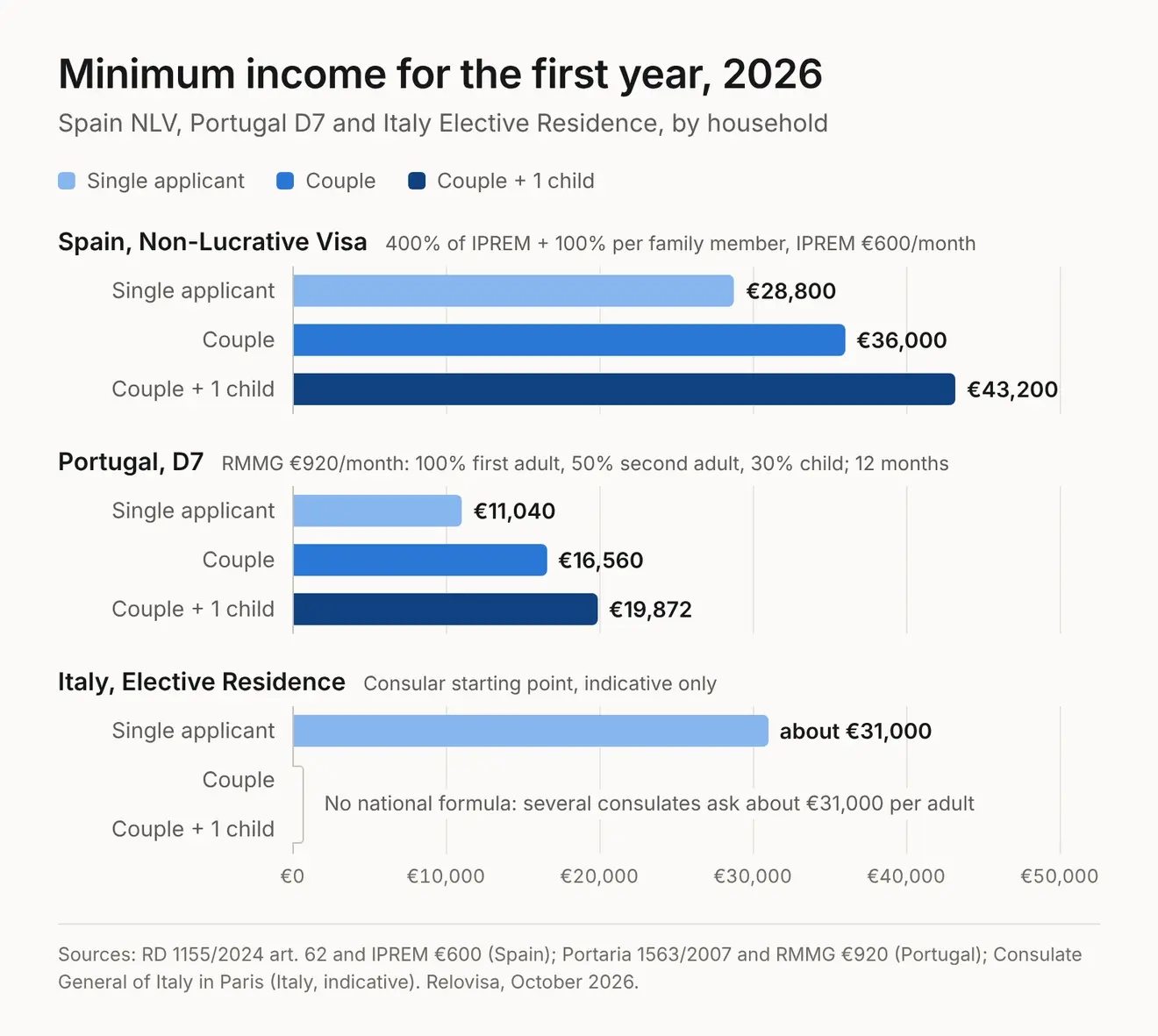
Article 62 of Royal Decree 1155/2024, in force since 20 May 2025, sets the floor at 400% of IPREM per month for the applicant and 100% for each family member, and requires the total for the full period of the authorisation. IPREM has stayed at €600 a month since the 2023 budget law (Ley 31/2022, additional provision 90): Spain has not passed a budget for 2024, 2025 or 2026, so the 2023 budget is automatically extended under Article 134.4 of the Constitution. With parliament dissolved on 6 October 2026 for elections on 29 November, the same figure is likely to apply into 2027 unless a decree-law changes it. The 2026 figures are €2,400 a month, or €28,800 for the first one-year permit, plus €7,200 a year per family member. A couple needs €36,000 for the first year; a couple with one child, €43,200. The Washington consulate publishes the same 2026 amounts (€28,800 and €7,200).
You can show either the capital or a regular income stream, which makes Spain the friendliest of the three to people living on savings. Two details catch people out. Foreign bank evidence must name the bank and the account and show the balance on 31 December of the previous year and the average balance over the last year (Article 62.3), so money moved in last month looks weak. And if your income comes from shares in a Spanish company, or a foreign company based in Spain, you must declare that you do not work in it.
"Family" has a narrow meaning here: a spouse or registered partner, children under 18 and adult children who depend on you because of disability or health. Parents cannot be included on an NLV under the 2024 regulation (Article 61.3), even though some consulate pages still mention them.
Portugal: the minimum wage, scaled by household
Portugal ties the D7 to the guaranteed minimum monthly wage (RMMG), which Decreto-Lei 139/2025 set at €920 from 1 January 2026. Portaria 1563/2007 values each household member against it: 100% for the first adult, 50% for each further adult and 30% for each child under 18 or dependent adult child. That gives €920 a month for one person, €1,380 for a couple and €1,656 for a couple with one child.
The same order requires the means to cover at least 12 months, so a single applicant shows at least €11,040, a couple €16,560 and a couple with one child €19,872. It also names the evidence: a pensioner proves the pension and that it will be received in Portugal, or that other income is available there; someone living on rent, dividends, royalties or investments proves the existence and amount of that income and its availability in Portugal. That last phrase is why many posts ask for a Portuguese bank account before they decide. The UK visa centre's 2026 checklist, for example, asks for a recent Portuguese bank statement showing at least €11,040 for a single applicant, a Portuguese tax number (NIF), three months of statements showing the declared income arriving, and a 12-month lease registered with the tax authority.
The legal minimum is not the number we put on a file. In our own D7 applications we show from €12,000 for the main applicant, plus 50% for a spouse and 30% per child, with a traceable history of six to twelve months and no lump deposits just before filing. The margin above €11,040 costs little and makes the most common reason for a second look less likely.
The money test is low, and that is the trap: the D7 is assessed on passive income. A salary or freelance invoices presented as D7 income is the classic refusal, and it belongs on the D8 instead. We compare the four Portuguese routes in D2 vs D3 vs D7 vs D8.
Italy: a formula that consulates treat as a starting point
Italy's rule sits in Interministerial Decree 850/2011, Annex A, point 13, still the governing text in 2026. It asks for "ample, stable and regular" own resources whose continuation can reasonably be assumed, not lower than three times the annual amount in Table A of the Interior Ministry directive of 1 March 2000, coming from substantial pensions or annuities, property, stable business holdings or other sources than salaried employment. Three times Table A's figure for one person comes to about €31,160 a year, which consulates round to about €31,000 (Sydney quotes €2,600 a month). The Paris consulate says this is only one parameter, because the visa is aimed at applicants with very high economic means.
Three practical consequences follow. First, work income does not count: the decree excludes salaried work, and consulates such as Paris also refuse self-employment income, even when it is paid from abroad. Second, savings on their own are a weak basis: the test is recurring income, and the Sydney consulate states that bank deposits and savings are not taken into consideration. That is the sharpest difference between Italy's Elective Residence and Spain's Non-Lucrative Visa, where a capital balance covering the permit period is enough. Third, there is no official family formula. The decree lets your spouse, minor children and dependent adult children who live with you get the same visa if your means are judged adequate for them too, and consulates read that differently: New York, Boston and the Washington embassy ask for about €31,000 per applicant, and Houston quotes €62,000 for a married couple. Figures such as "+20% for a spouse" circulate online but are not on any official page we checked, so budget for the full amount per adult unless your consulate says otherwise.
Italy also tests housing harder than the others. The Paris consulate accepts only a registered rental contract or a property deed in Italy, and US consulates ask for a lease registered with the Agenzia delle Entrate that covers the visa period. Hotel bookings and offers of hospitality from friends are refused.

Comparing Spain with Portugal or Italy for your own numbers? The Non-Lucrative Visa asks for more than twice Portugal's D7 bar and is the clearest of the three about what it forbids, so the file stands or falls on how the funds are evidenced. See how the Spain Non-Lucrative Visa route works →
Applying: paperwork, timing and fees
All three are filed at the consulate for the place where you legally live, before you move. None can be started from a tourist stay in the country.
- Spain asks for private health insurance from an insurer authorised in Spain, with full cover and no copayments or waiting periods (UK pensioners can use a registered S1 at the London consulate), a criminal record certificate for every country you lived in during the last five years, a medical certificate and a passport valid for at least a year. Government fees are small: €10.94 for the residence authorisation and €16.08 for the first residence card, plus the consular visa fee (US$140 for US citizens in 2026). The regulation gives the immigration office one month to decide, with silence counting as a refusal (Article 63.4), and the consulate one more month to issue the visa; consulates quote two to three months in practice.
- Portugal issues a residence visa valid for four months and two entries, with a 60-day consular decision period. The consular fee is €110 per applicant. Expect to show travel medical insurance for the visa period, a criminal record certificate, the 12-month registered lease and, in practice, the NIF and Portuguese bank account described above.
- Italy reviews the file in up to 90 days and asks for health insurance with at least €30,000 of cover (Paris), the registered lease or deed, and the income evidence. Since January 2025 every applicant for an Italian national visa is fingerprinted at the appointment.
Can you, or your spouse, work?
This is where the three routes differ most, and where the choice matters most.
Spain: no work for anyone on the permit. Article 61.1 defines the status as residence "without carrying out work or professional activities", for the holder and the family members included in it. The London consulate states plainly that the visa is not a work permit, the Washington consulate asks for a declaration that you will not do lucrative work "either on-site nor remotely (online)", and Madrid's High Court of Justice has upheld refusals of applicants who planned to keep working online, in one 2023 case because the applicant still offered services on LinkedIn.
A spouse who wants to work has two routes. Inside Spain, Article 191 allows a change to an employee or self-employed permit; after one year of residence it no longer requires the labour-market test, but it does require a job contract or a viable business. Alternatively, a spouse who does not come on the NLV can join later through ordinary family reunification, open once you have lived in Spain for a year and applied to renew (Article 68.1), and that permit allows work from day one (Article 65.2). Switching from the NLV to the Digital Nomad Visa inside Spain looks possible on paper, since anyone legally in Spain may apply. But the DNV requires a working relationship with your employer or clients of at least three months at the date of application, which an NLV holder cannot show without having broken the no-work rule. We cover this in switching to the DNV from inside Spain.
Portugal: the permit carries the right to work, and the family file timing matters. Article 83 of Lei 23/2007 gives every residence-permit holder the right to employed and self-employed work without a separate authorisation, and family members who come with you receive residence permits of their own, so your spouse can work too. If AIMA has not decided your permit through no fault of yours, Article 81.4 already lets a residence-visa holder work while it is pending.
Since 23 October 2025, when Lei 61/2025 took effect, how the family travels matters as much as the money. Your spouse and children can apply for accompanying visas at the same consulate at the same time as you (Article 58.5), and that is the route to use. A spouse who follows later goes through family reunification, which is now open only once you have held your permit for two years (Article 98.1), or 15 months if you lived together for at least 18 months before you moved (Article 98.2). Minor children, and a spouse who is the other parent of a minor child, are exempt (Article 98.3); D7 holders are not on the list of permits whose families skip the wait. What the law does not change is the logic of the route: the D7 was granted on passive income, and that income is checked again at renewal. If you plan to earn mainly from work, file for the D8 or another work route from the start.
Italy: no work for anyone on the permit. The decree says the visa allows residence "without carrying out any work activity", and the Los Angeles consulate adds that the holder may not work or look for work "under any conditions". The spouse and children receive the same type of visa, so the same rule applies to them. There is a way out, but it is not a shortcut: the elective-residence permit is on the list of permits that can be converted into a work permit if you meet that permit's own requirements (Article 6.1-bis of the Testo Unico Immigrazione). Italy also offers no later family-reunification route for this permit: elective residence is not one of the permits that give a right to family reunification (Article 28.1), so a spouse who joins later applies for their own elective-residence visa on the same means test.
Living there: renewals and time away
- Spain issues a one-year first permit (Article 61.4), then two-year renewals (Article 64.7). Each renewal needs means for the full two years, so €57,600 for one person plus €14,400 per family member at the 2026 IPREM, continuous health insurance, schooling for children of compulsory school age and proof that you lived in Spain for more than 183 days in the calendar year (Article 64.2). Apply in the two months before expiry; a filing up to three months late is still accepted but can bring a fine. The immigration office has three months to decide, and silence counts as approval (Article 64.8).
- Portugal grants a temporary residence permit valid for two years from the date the card is issued, renewable for three (Article 75.1). Since Lei 62/2026 took effect on 11 September 2026, AIMA must decide a first permit within 90 days, extendable once by 30 days in exceptional cases (Article 82.5), and a renewal within 60 days (Article 82.6); real waits are often longer. Apply to renew at least 30 days before the card expires (Article 78.1): a renewal AIMA has not decided in time is no longer treated as approved, but the renewal receipt stands in for the card in the meantime. AIMA can cancel a temporary permit if you are away for six consecutive months or eight non-consecutive months during its validity without good reason (Article 85.2).
- Italy gives you eight working days after arrival to apply to the Questura for the permesso di soggiorno, which follows the length of the visa. Each renewal is checked against the same conditions as the first permit and must be requested at least 90 days before expiry (Article 5.4 of the Testo Unico Immigrazione, in force since 22 May 2026). It is refused if you have been out of Italy for more than six consecutive months without a serious documented reason (Article 13.4 of Presidential Decree 394/1999).
Five years to permanent residence, ten (or seven) to citizenship
All three reach long-term status after five years. In Spain that is EU long-term residence after five years of legal and continuous residence; absences of up to six consecutive months, ten in total, do not break continuity (Article 176). In Portugal, permanent residence after five years as a temporary-permit holder, with means of subsistence, housing, basic Portuguese and no prison sentence over one year in that period (Article 80). In Italy, the EU long-term permit after five years on a valid permit, with income at least equal to the annual social allowance (€7,101.12 in 2026), suitable housing and a basic Italian language test (Article 9 of the Testo Unico Immigrazione).
Citizenship by residence is generally ten years in Spain (two for nationals of Ibero-American countries and a few others), ten years for non-EU nationals in Italy, and in Portugal ten years, or seven for EU citizens and nationals of countries where Portuguese is an official language, since Lei Orgânica 1/2026 entered into force on 19 May 2026 (Article 6.1.b of the Nationality Law). In Portugal the old rule that counted time from the date you applied for your residence permit has been repealed, so plan on the clock running from lawful residence on your visa and permit; the new language and civics test still has no implementing regulation. How the clocks compare across more countries is in the EU citizenship timeline, and what long-term status gives you is in the EU long-term residence guide.
The tax question, briefly
None of these visas is a tax regime. Live in the country for most of the year and you become an ordinary tax resident, usually taxed on worldwide income.
- Spain: the 183 days you need for renewal are the same threshold that makes you a Spanish tax resident, so plan on being taxed on worldwide income from your first full year. The Beckham Law is not open to NLV holders: since the 2023 Startups Law it covers a move for an employment contract (remote work included), a company directorship or qualifying entrepreneurial or professional activity, all of which the NLV forbids. Pensions follow the progressive scale and investment income the savings scale of 19% to 30%. Spain also taxes residents' net wealth above a regional allowance (by default €700,000, plus up to €300,000 for the main home); Madrid and Andalusia currently give full relief, but the state solidarity tax on net wealth above €3 million still applies there. Foreign accounts, securities and property worth more than €50,000 in any category must be reported on Modelo 720.
- Portugal: the NHR regime closed to new entrants from 1 January 2024 (Lei 82/2023, Article 236); a transitional window let people who became tax resident by 31 December 2024 register until 31 March 2025. Its successor, IFICI, is open only to people who move to carry out a qualifying professional activity, so living on a pension or investments does not qualify, and foreign pensions are outside it in any case. Pensions are taxed at the progressive IRS rates, 12.5% to 48% in 2026. The IFICI vs Beckham comparison explains what each regime covers.
- Italy: two optional regimes target new residents. Foreign-pension holders who move to a town of no more than 30,000 inhabitants in Sicily, Calabria, Sardinia, Campania, Basilicata, Abruzzo, Molise or Puglia, or in listed earthquake areas, can pay a flat 7% on all foreign income for the year of the move and the following nine years, if they were not Italian tax resident in the previous five years and come from a country that exchanges tax information with Italy (Article 24-ter of the income tax code; the population cap rose from 20,000 on 7 April 2026). Wealthier movers can instead pay a fixed €300,000 a year on foreign income, plus €50,000 per family member, for up to 15 years, after a favourable ruling from the Agenzia delle Entrate (Article 24-bis). Both regimes also lift the taxes on foreign property and financial assets (IVIE and IVAFE) for the countries covered. From 1 January 2027 both move into Italy's new income tax code (Legislative Decree 117/2026, Articles 246 and 247), which keeps them.
Treaties and your home country's rules often change the outcome, so the tax comparison belongs in a consultation with your actual income.
Which route fits which profile
- A modest pension or rental income, and you might want to work later: Portugal's D7. The lowest bar, a two-year first permit and a work right for you and your spouse once you hold the permit, provided the family files together.
- Comfortable passive income or savings, no plans to work, and Spain is where you want to live: the NLV. The bar is higher and the no-work rule is strict, but savings count, the evidence rules are clear and the renewals are predictable if you meet the 183 days and the doubled renewal amount.
- High, stable passive income (not just savings) and a firm wish to settle in Italy: Elective Residence. Expect a discretionary review, a registered lease or deed before you file, about €31,000 a year per adult at several consulates, and no work for anyone in the family. If you hold a foreign pension and like the south, look at the 7% regime too.
- You still work remotely: none of the three is designed for you. Look at the Spanish, Portuguese or Italian digital nomad routes instead, compared side by side in our Spain, Portugal and Italy nomad visa comparison.
Mistakes that cost people the visa or the renewal
- Choosing a passive-income visa and planning to keep working online. Spain and Italy forbid it outright and Spanish courts have upheld refusals over it; in Portugal the work income will not carry a D7 renewal.
- Moving money just before filing. Spain asks for year-end and average balances, Portugal for proof of regular income and availability in Portugal. A sudden deposit invites questions about its origin.
- Counting savings for Italy. Spain accepts capital, but Italian consulates test recurring passive income; a large balance with no income stream behind it is weak evidence.
- Sending the family later to Portugal. A spouse who does not apply with you must now wait until you have held your permit for two years (15 months if you lived together for at least 18 months before the move), unless you have a minor child together.
- Budgeting the Spanish renewal at the first-year figure. The first permit needs €28,800 for one person; the two-year renewal needs €57,600.
- Treating the residence as a backup address. Spain checks 183 days at every renewal, Portugal can cancel a permit for long absences, Italy refuses renewal after more than six consecutive months away, and every route counts absences again for permanent residence and citizenship.
- Booking short-term accommodation for an Italian file. Only a registered lease or a deed counts.
How Relovisa can help
We work on all three routes: the Spain Non-Lucrative Visa, the Portugal D7 and Italy's Elective Residence. On a first consultation we check your income type and amount against each country's test, the family members you plan to include and how much time you will really spend in the country, and tell you which file is realistic before you collect documents.
Want your numbers checked against all three tests? Start with the Spain Non-Lucrative Visa route →, or go straight to the Portugal D7 → or Italy Elective Residence → page.
Sources
- Spain, Real Decreto 1155/2024 (immigration regulation), Articles 26, 38, 61-65, 68, 176 and 191, consolidated text updated 22 September 2026, verified October 2026: https://www.boe.es/buscar/act.php?id=BOE-A-2024-24099
- Spain, Ley 31/2022 (2023 State Budget), additional provision 90, IPREM €600 a month, applicable in 2026 through the automatic budget extension of Article 134.4 of the Constitution, verified October 2026: https://www.boe.es/buscar/act.php?id=BOE-A-2022-22128
- Consulate General of Spain in Washington, non-lucrative residence visa (2026 amounts €28,800 and €7,200; no on-site or remote work), verified October 2026: https://www.exteriores.gob.es/Consulados/washington/en/ServiciosConsulares/Paginas/Consular/Visado-de-residencia-no-lucrativa.aspx
- Consulate General of Spain in London, non-lucrative residence visa (400% and 100% IPREM; not a work permit; two-month decision period; S1 accepted), page updated 6 July 2026, verified October 2026: https://www.exteriores.gob.es/Consulados/londres/en/ServiciosConsulares/Paginas/Consular/Visado-de-residencia-no-lucrativa.aspx
- Spain, Ley 14/2013, Article 74 quinquies (digital nomad applications from inside Spain), verified October 2026: https://www.boe.es/buscar/act.php?id=BOE-A-2013-10074
- Noticias Jurídicas, Madrid High Court of Justice upholds an NLV refusal because the applicant kept offering professional services online (2023), verified October 2026: https://noticias.juridicas.com/actualidad/jurisprudencia/18487-el-tsj-madrid-deniega-el-visado-de-residencia-no-lucrativa-por-continuar-ofreciendo-servicios-profesionales-en-linkedin/
- Spain, Ley 5/2022 (Modelo 720 reform after the CJEU ruling in C-788/19), verified October 2026: https://www.boe.es/buscar/doc.php?id=BOE-A-2022-3712
- Portugal, Lei 23/2007 (immigration law), Articles 58, 75, 78, 80 to 83, 85 and 98, consolidated to Lei 62/2026, verified October 2026: https://www.pgdlisboa.pt/leis/lei_mostra_articulado.php?nid=920&tabela=leis
- Portugal, Lei 61/2025 of 22 October (family reunification, Article 98), verified October 2026: https://diariodarepublica.pt/dr/detalhe/lei/61-2025-941547426
- Portugal, Lei 62/2026 of 10 September (AIMA decision deadlines, Article 82), Diário da República 1.ª série n.º 176, verified October 2026: https://files.diariodarepublica.pt/1s/2026/09/17600/0006000111.pdf
- Portugal, Portaria 1563/2007 (means of subsistence), Articles 2 and 5, Diário da República 1.ª série n.º 238, 11 December 2007, verified October 2026: https://files.diariodarepublica.pt/1s/2007/12/23800/0886608868.pdf
- Portugal, DGERT, guaranteed minimum monthly wage for 2026 (€920, Decreto-Lei 139/2025), verified October 2026: https://www.dgert.gov.pt/retribuicao-minima-mensal-garantida-para-2026
- Portugal, Ministry of Foreign Affairs visa portal, residence visa documentation, means of subsistence and fees, verified October 2026: https://vistos.mne.gov.pt/pt/vistos-nacionais/documentacao-instrutoria/residencia
- VFS Global for the Portuguese consulate in London, D7 checklist dated 6 March 2026, verified October 2026: https://www.vfsglobal.com/one-pager/portugal/uk/english/pdf/D7-RESIDENCE-VISA-FOR-RETIREMENT-RELIGIOUS-OR-FOR-LIVING-FROM-INDIVIDUAL-REVENUES.pdf
- Portugal, Lei Orgânica 1/2026 (nationality law amendment, in force 19 May 2026), verified October 2026: https://files.diariodarepublica.pt/1s/2026/05/09500/0000200020.pdf
- Portugal, Código do IRS, Article 68 (2026 income tax rates), verified October 2026: https://info.portaldasfinancas.gov.pt/pt/informacao_fiscal/codigos_tributarios/cirs_rep/Pages/irs68.aspx
- Italy, Decreto Interministeriale 850/2011, Annex A, point 13 (residenza elettiva), verified October 2026: https://www.esteri.it/mae/normative/Normativa_Consolare/Visti/Decreto_Interministeriale_850_11-5-2011.pdf
- Consulate General of Italy in Paris, elective residency visa (about €31,000 as one parameter; no work; registered lease or deed; €30,000 insurance; up to 90 days), verified October 2026: https://consparigi.esteri.it/it/servizi-consolari-e-visti/servizi-per-il-cittadino-straniero/visti/residenza-elettiva-elective-residency/
- Consulate General of Italy in Los Angeles, elective residency visa (no work or job search under any conditions; Questura within 8 days; fingerprints for all national visa applicants since 11 January 2025), verified October 2026: https://conslosangeles.esteri.it/en/servizi-consolari-e-visti/servizi-per-il-cittadino-straniero/visti/visa-type/elective-residency-visa/
- Consulate General of Italy in New York, elective residency visa (about €31,000 per applicant), verified October 2026: https://consnewyork.esteri.it/en/servizi-consolari-e-visti/servizi-per-il-cittadino-straniero/visti/visas-to-enter-italy/elective-residency/
- Consulate General of Italy in Boston, elective residency visa (about €31,000 per applicant), verified October 2026: https://consboston.esteri.it/en/servizi-consolari-e-visti/servizi-per-il-cittadino-straniero/visti/elective-residency/
- Embassy of Italy in Washington, elective residency visa requirements (about €31,000 per applicant), verified October 2026: https://ambwashingtondc.esteri.it/wp-content/uploads/2025/03/ELECTIVE-RESIDENCY-VISA.pdf
- Consulate General of Italy in Houston, elective residence checklist, July 2026 (€62,000 for a married couple), verified October 2026: https://conshouston.esteri.it/wp-content/uploads/2026/07/ELECTIVE-RESIDENCE.docx
- Consulate General of Italy in Sydney, elective residency visa checklist, July 2026 (savings not taken into consideration), verified October 2026: https://conssydney.esteri.it/wp-content/uploads/2026/07/ELECTIVE-RESIDENCY-VISA-checklist.pdf
- Italy, Decreto legislativo 286/1998 (Testo Unico Immigrazione), Articles 5, 6, 9 and 28, verified October 2026: https://www.normattiva.it/uri-res/N2Ls?urn:nir:stato:decreto.legislativo:1998-07-25;286~art9
- Italy, Presidential Decree 394/1999, Article 13 (renewal and absences), verified October 2026: https://www.normattiva.it/uri-res/N2Ls?urn:nir:presidente.repubblica:decreto:1999-08-31;394~art13
- Prefettura di Roma, citizenship by residence (ten years for non-EU nationals, Law 91/1992 Article 9.1.f), verified October 2026: https://prefettura.interno.gov.it/it/prefetture/roma/informazioni-generali-cittadinanza-residenza
- Italy, Agenzia delle Entrate, optional 7% regime for foreign pensioners (Article 24-ter TUIR), verified October 2026: https://www.agenziaentrate.gov.it/portale/schede/agevolazioni/regime-opzionale-per-i-pensionati-esteri-che-cose-cittadini
- Italy, Legge 34/2026, Article 26 (7% regime population cap raised to 30,000), verified October 2026: https://www.normattiva.it/uri-res/N2Ls?urn:nir:stato:legge:2026-03-11;34~art26
- Italy, Legge 199/2025, Article 1, paragraphs 25-26 (€300,000 and €50,000 flat tax for new residents), verified October 2026: https://www.normattiva.it/uri-res/N2Ls?urn:nir:stato:legge:2025-12-30;199~art1-com25
- Italy, Decreto legislativo 117/2026 (new income tax code, Articles 246 and 247), Gazzetta Ufficiale 3 July 2026, verified October 2026: https://www.gazzettaufficiale.it/eli/gu/2026/07/03/152/so/26/sg/pdf